Think about the last time you asked yourself where did the money go this month? You probably opened one app. Whichever bank pays your rent, most likely. It showed you a number, and the number felt incomplete, and you closed the app.
It was incomplete. Here is roughly how incomplete.
The numbers
FICO surveyed 19,000 consumers across 19 countries about who they bank with.1 Three findings, taken together, describe the problem exactly:
- 74% use more than one financial provider.
- 19% use more than four.
- 90% still name a single institution as their “primary” bank, the one they think of as their bank.
Accenture’s 2025 study of 49,300 customers across 39 countries measures the same split from the other side: consumers hold an average of 6.3 financial products, and only about half of them sit at their main bank.2
Nine in ten people have a bank they think of as theirs. Three in four have money moving somewhere else as well.
Why the accounts multiply
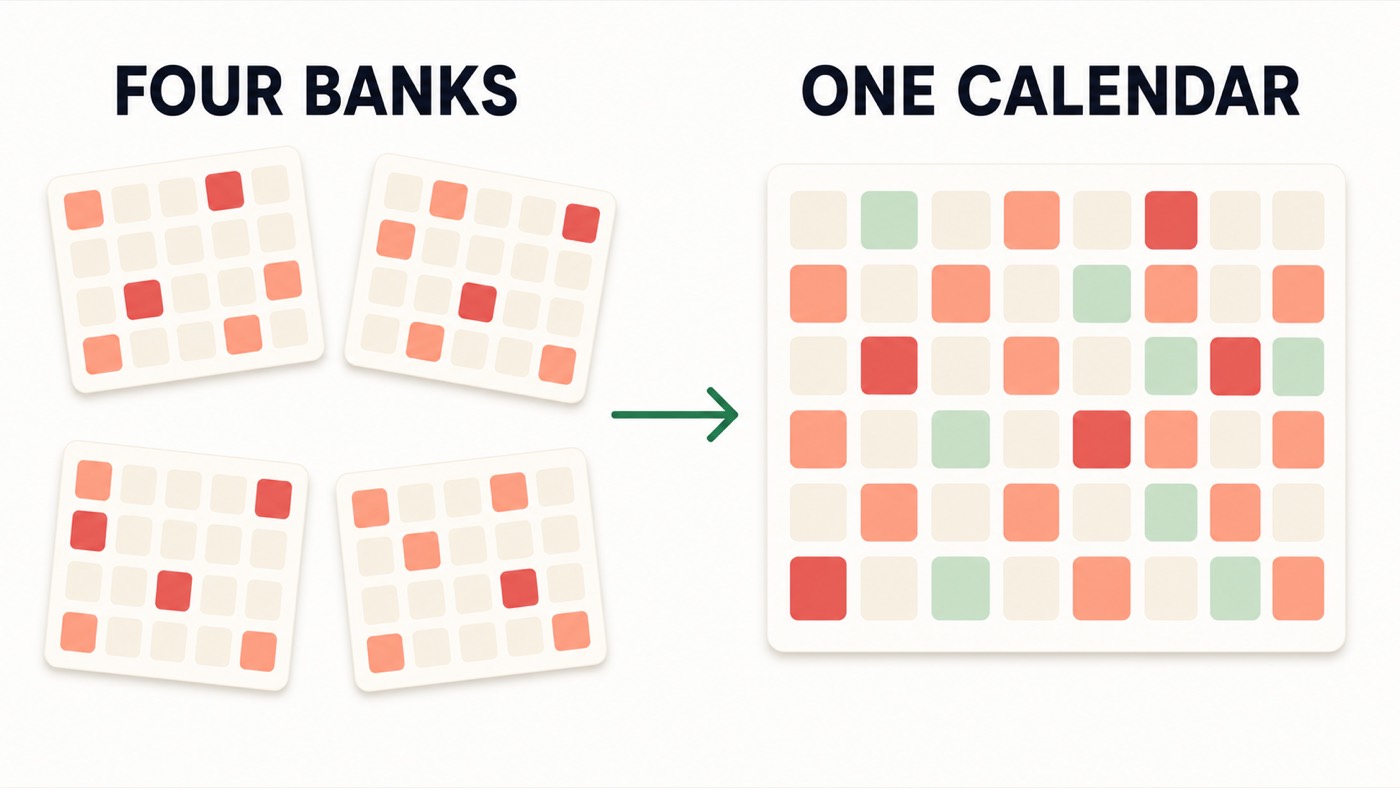
Nobody sets out to run four banks. It happens one reasonable decision at a time. A salary account from a first job. A joint account when you move in with someone. A challenger app because the card was free and the exchange rate was better. A card in another currency because you spent a year abroad, or your family did, and closing it felt like more trouble than keeping it.
Each account arrived for a good reason. What nobody signed up for is the arithmetic: your spending is now spread across four ledgers, and no single app can see more than one of them.
What one app actually hides
A single bank’s monthly summary is not wrong. It is just answering a smaller question than the one you asked. Specifically, it cannot see:
- Duplicated categories. Groceries look modest at your main bank because half of them go on the challenger card.
- Transfers that look like spending. Moving €300 to your own second account leaves your primary bank looking €300 poorer. It was never spent.
- Heavy days. A Saturday that cost €40 in one app and €120 in another was a €160 Saturday. Neither app will ever tell you that.
- The direction of travel. If spending quietly migrates from one card to another, both apps show a flat line. Nothing changed, as far as either can tell.
The last one is the expensive one. Migration between your own accounts is invisible from inside any single account, which means the one pattern you would most want to catch is precisely the pattern no bank app is built to show you.
What to do about it
You do not need an app to fix this. You need one surface that all the accounts land on. Three ways to get one, in ascending order of effort:
- Consolidate. Genuinely close what you no longer use. The best account to reconcile is the one that no longer exists. This works less often than people hope, because most of those accounts still have a job.
- Add them up by hand. Once a month, open each app, write the totals in one place. Tedious, free, and it works. Most people stop by month three.
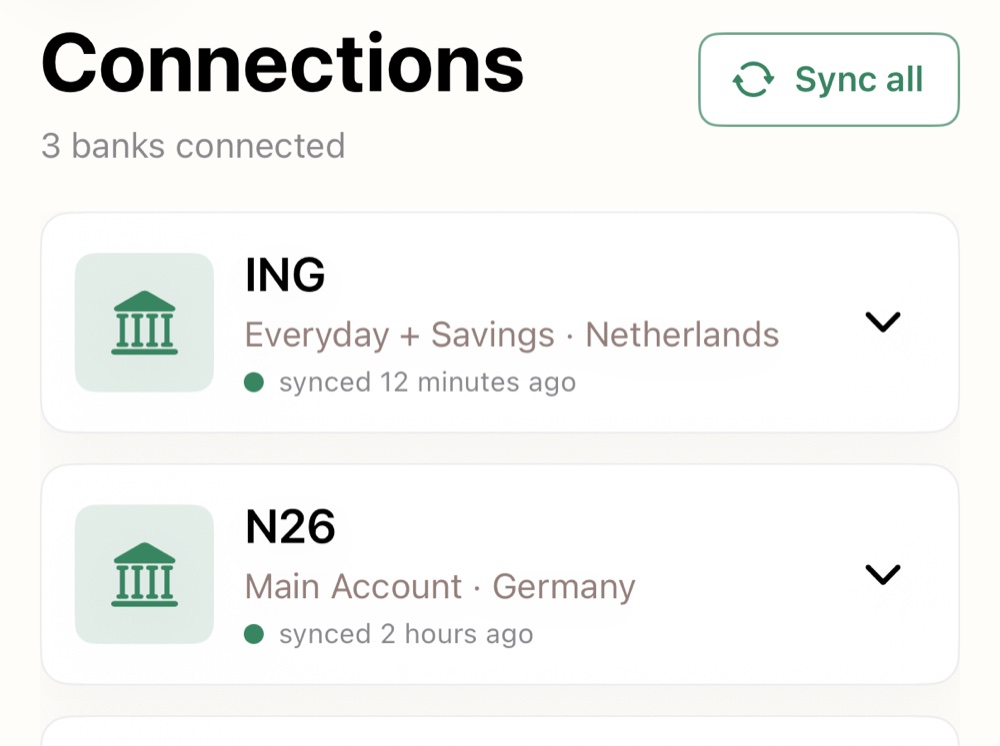
- Use something that reads all of them. Open banking exists for exactly this: a read-only, revocable permission that lets one app see the balances and transactions of accounts held at other banks. That is what the next guide is about.
The one thing worth remembering
Your primary bank is not lying to you. It is showing the accounts it can see, with no context from the supported accounts you hold elsewhere. The fix is not another chart of the same slice. It is a wider view.
Sources
- FICO, Bank Customer Experience Survey (19,000 consumers, 19 countries). fico.com
- Accenture, Global Banking Consumer Study 2025 (49,300 customers, 39 countries). accenture.com
See supported accounts on one calendar
Pocket Pivot colours each day by the history available from supported accounts you connect.
Get the launch emailPocket Pivot is a spending-awareness tool. Nothing here is financial, investment, tax or legal advice.